Learning from Our Experiences as We Grow Wiser & More Resilient
Welcome to this month’s Flourish!
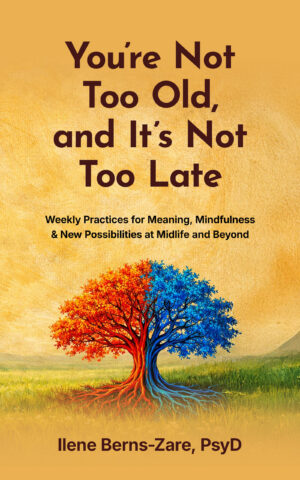
As we begin: You’re Not Too Old, and It’s Not Too Late is available now!
Designed as an accessible 52-week companion, this inspiring book invites Baby Boomers and Gen Xers to reimagine aging with confidence, vitality, and purpose. Drawing on research-informed tools and practical reflections, it encourages readers to tap into inner strengths, embrace meaningful shifts, and discover everyday “ah-ha” moments that spark renewal.
Please click here to learn more and enjoy your copy.
And now, here’s this month’s Flourish blog:
Not long ago, with a busy day ahead, I thought I’d get a few things done at the same time. With two books under my arm and phone in hand, I picked up a glass of tea and a piece of chocolate to carry to the table for a quick email scan. No surprise — the glass dropped, shattering across the ceramic floor. Rather than saving 15 seconds, my choice to briskly multi-task resulted in 15 unhappy minutes spent cleaning up the glass and tea from the floor. What did I learn from this experience?
We all experience varied events each day — good times, difficult times, challenges, and opportunities. We may not have influence over external events or life’s inevitable challenges, but we do have influence over our choices and responses.
One of the big resilience-inspiring strategies available to each of us involves reflecting on self-inquiries such as these:
‘What have I learned from this experience?’ and ‘What can I learn?’

If we are motivated toward resilience and moving forward from life’s ups and downs, we may want to reflect on our experiences in ways that provoke expanded awareness, understandings, and greater wholeness. This kind of explorative mindset can reap many benefits. For example, why do some people learn and gain greater wisdom from experience, while others do not?
Psychologists Judith Gluck, Susan Bluck, and Nic Westrate(2018) propose five resources linked to developing wisdom and learning from life’s experiences:
- Having a sense of mastery – Trusting in your capacity to cope with and handle life’s circumstances; having the ability to accept situations you can’t control and taking action on those you can.
- Openness to experience – Willingness to look at situations from a variety of viewpoints. Seeking out new ideas, experiences and emotions and exploring goals and values that differ from your own.
- Reflectivity – Willingness to examine your experience and think about complex issues in a deep, thoughtful way. Being willing to question and think critically about ideas, assumptions, and experiences to gain greater understanding and insight.
- Emotional Regulation – Having the capacity to tolerate emotions, manage emotions, and learn from your responses to varied situations.
- Empathy – Concern for others. The ability to understand and share the feelings of others, not just family and friends, but also people in the larger world.
Learning from experience can build resilience, the ability to adapt to life’s challenges. Research has shown that when learners have a growth mindset, they believe that their abilities can develop and expand; that with experience and hard work they can get better at things. With a growth mindset, people are more resilient and can learn more effectively (Dweck, 2006; Stanford University, 2024).
The process of learning by doing, experiential learning, can strengthen your ability to grow, promoting self-assessment, social-emotional-cognitive development, enhanced understandings, problem-solving, skill building, and decision-making. One resilience-inspiring strategy involves reflecting on questions such as these: “What have I learned from this experience?” and “What can I learn?”
3 Strategies to Help You Learn from Experience:
Some of us may want to ponder our experiences with personal reflection, mindful moments, contemplation, or prayer. Others may choose to write, jot notes, or create visuals. It can be convenient to collect these in a journal — handwritten or electronic – perhaps creating a notes page on a phone, tablet, computer, or dictating into an electronic speech-to-text app.
1 – Acknowledging and reflecting on your experience. Anyone can choose greater learning, rather than slipping into familiar habits. To strengthen your awareness, learning and insight, you might choose to consider your inner journey, to mindfully notice your own experience and the experiences of others.
One useful tool is the PARDA 5-Step Awakening and Action Process (Berns-Zare, 2025)
- Pause and notice the flow of your breathing.
- Actively Listen to your intuitive wisdom and inner voice.
- Reflect on your experience – with self-compassion, notice your thoughts, feelings, and bodily sensations.
- Discern as you sift through your awareness, realities, possibilities, and choices.
- Act with intention. What’s the next right thing? Mindfully choose your next steps for reflection or action.
Pause. Actively listen. Reflect. Discern. Act mindfully to choose your next steps.
2 – Asking yourself thought provoking open-ended questions may help you stimulate reflection and openness to your experience. Remember to be open to compassion for yourself and others in this process. You may return to these questions as many times as desired to meaningfully reflect. Here are some questions you might consider:
- What can I learn from this experience?
- What went well? What might I do differently next time?
- Where does self-compassion fit for me?
- Which of my strengths can I leverage here?
- What can I learn about myself, about others, and about the situation?
- How can I grow from this experience?
3 – Learning and growing with others. As you reflect on your experiences and seek to gain mastery in coping with them, you may find it helpful to learn in friendship or partnership with others. You can explore, discuss, debate with others, as you actively listen and also share with them, whether or not you agree with their viewpoints. As it fits you, you might choose to engage your inner knowing that you are part of something much larger than yourself.
We face joys and adversities as we live our lives. Moving toward a mindset of learning from our experiences offers opportunities to grow wiser and more resilient.
Coaching with Ilene Can Help You Call Yourself to Action
Ilene Berns-Zare, PsyD, PCC, CEC, is an Executive and Personal Coach and Speaker. Ilene helps people live their best personal and professional lives by bringing mind, body, and spirit into flow with strengths, purpose, and potential. Ilene is the author of You’re Not Too Old, and It’s Not Too Late: Weekly Practices for Meaning, Mindfulness and New Possibilities at Midlife and Beyond. She inspires people to find fresh perspectives and access their full potential as creative, resourceful, whole persons. Find Ilene online and access free resources at ibzcoaching.com

Review: Reviewed by Stewart Brian for Readers’ Favorite
” You’re Not Too Old, and It’s Not Too Late by Ilene Berns-Zare is a well-written book that offers readers practical strategies to empower them and transform their ideas about growing older. Ilene begins by sharing tips on how readers can get the most out of this book, as well as her inspiration for writing it. She also discusses how resilience skills, mindfulness, positive psychology, and embracing change and growth, among other factors, contribute greatly to a person’s well-being and ability to experience more joy and a meaningful life as they move through midlife and into old age. Other crucial topics included are supportive and mindful communication strategies, the power of habits, taking actions toward your goals, and more.
Before reading it, I had a few negative ideas and fears about aging; however, this book completely transformed my perspective and offered me a deeper understanding of how I can live more meaningfully as I grow older. I commend Ilene for sharing from her personal experiences, which made this book more relatable and appealing to me. I also commend the author for the amount of research that has been invested and the many references that further validate the information. I love the inspiration sections, the practical exercises, and the reflection questions, which made this book very engaging. The writing is detailed, well-paced, organized, and easy to comprehend. It featured themes on personal growth, positive aging, self-care, and more. I recommend You’re Not To Old, and It’s Not Too Late by Ilene Berns-Zare to anyone who desires a fulfilled and impactful life as they grow older. “
For information on Ilene’s new book, click here:
You’re Not Too Old, and It’s Not Too Late
Send your comments and suggestions to Ilene!
Click here to send an email with your thoughts about this newsletter.
References for this month’s blog – Learning from Our Experiences:
-
- Berns-Zare, I. (2025). You’re not too old and it’s not too late: Weekly practices for meaning, mindfulness and new possibilities at midlife and beyond. Hollister, CA: MSI Press. https://www.amazon.com/Youre-Not-Too-Late-Possibilities/dp/195735495X
- Berns-Zare, I. (2024). Why is gratitude so good for you: 5 steps to infuse your life with more gratitude and action. https://www.psychologytoday.com/us/blog/flourish-and-thrive/202403/why-is-gratitude-so-good-for-you
- Berns-Zare, I. (2020). 5 steps for greater perspective and a positive shift: This 5-step awakening process may help you re-energize, reduce negativity and gain greater clarity.https://www.psychologytoday.com/us/blog/flourish-and-thrive/202011/5-steps-for-greater-perspective-and-a-positive-shift
- Dweck, C. S. (2006). Mindset: The new psychology of success. New York, NY: Random house.
- Glück, J., Bluck, S., & Weststrate, N. M. (2019). More on the MORE life experience model: What we have learned (so far). The Journal of Value Inquiry, 53, 349-370.https://link.springer.com/article/10.1007/s10790-018-9661-x
- Stanford University. (2024). Growth mindset and enhanced learning. https://teachingcommons.stanford.edu/teaching-guides/foundations-course-design/learning-activities/growth-mindset-and-enhanced-learning

Ilene is now on Bluesky Social! We invite you to join the conversation.

Ilene is a Featured Author on PsychologyToday!
Read her blog series Flourish and Thrive: Navigating transitions with mindfulness and resilience.

What are some ways you would like to maximize your personal or professional possibilities?
Tap into your strengths, purpose, and potential to flourish in life and work.
If you’d like to discuss how Ilene Berns-Zare Coaching can help you achieve your goals, contact Ilene.
Coaching with Ilene Can Help You Call Yourself to Action
Ilene Berns-Zare, PsyD, PCC, CEC, is an Executive and Personal Coach and Speaker. Ilene helps people live their best personal and professional lives by bringing mind, body, and spirit into flow with strengths, purpose, and potential. She inspires clients to find fresh perspectives and access their full potential as creative, resourceful, whole persons. Find Ilene online, set up a free discovery coaching consultation, and access free resources at https://ibzcoaching.com/.
Please share this blog with anyone who might be interested in reading it!
We would love to hear from you! We are interested in your suggestions for this newsletter, your reactions to this one, or providing more information about coaching.