Welcome to this month’s Flourish!
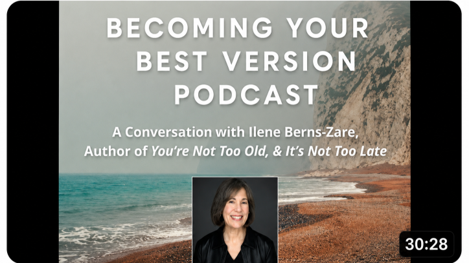
Ilene was interviewed about her new book You’re Not Too Old, & It’s Not Too
Late on the Becoming Your Best Version podcast by Maria Leonard Olsen. It’s
available on Spotify, Apple, and YouTube.
You can listen to the podcast here:
https://www.youtube.com/watch?v=6WXcKsqBAGQ
And now onto this month’s Flourish blog:
A few days after my mom died, a friend visited our home. After a heartfelt greeting, he simply said, “Tell me about your mom.” Of the many beautiful moments that accompanied this sad yet expectable loss, this compassionate inquiry was a standout. Why? Because the question was shared with kindness, love and a willingness to patiently listen.
This friend didn’t interrupt when I paused or when my tears of grief welled up. He patiently let me talk and didn’t tell me about his own lost loves, sorrows or losses. He simply stayed with me as he listened heartfully and attentively to my story.
I continue to appreciate the kind family and friends, younger and older, who reached out with genuine compassion during this time of loss.
How many of us want to talk about loss? It can be so difficult to sit with our own grief and losses and the grief and losses of others. In fact, after writing my new book, You’re Not Too Old, and It’s Not Too Late (MSI Press, 2025), I realized that I’d shared stories about people I’d lost but barely discussed loss directly. Of course, loss is not the topic of that book, but in retrospect, I know the source of my omission goes deeper than that. That book covers many topics regarding navigating the second half of life with meaning, mindfulness and new possibilities — I could have woven in loss a bit more but did not. At that point, I preferred to circumnavigate a direct discussion of loss and focus more on practices to lift ourselves with resilience as we face life’s challenges

Yet now, I feel more ready to directly acknowledge that losses sit prominently in the fabric of our life’s struggles and challenges, especially in the second half of life. I am more ready to recognize that the necessary and often inescapable losses life serves up will happen whether I write about them or not. Ready to acknowledge that losses will happen whether I like or dislike them. Sadly, ready to acknowledge that losses of so many varieties are all too prevalent and inevitable.
So, although I am not the first and will not be the last to write about losses, I feel the time has come for me to more gracefully embrace the broken places, to acknowledge the inevitable cracks in almost everything. I am reluctant to acknowledge these realities and, as my mom might have said, it’s time to stop kicking and screaming so much about it.
Thus, I am inviting myself, and you are welcome to join me, to consider possibilities for getting back up after each loss and life challenge knocks us down. Inviting resilience into the mix in intentional ways. To consider ways we can show up and accompany each other amid life’s struggles. And to explore the idea that our losses can invite us, as we’re ready, to rejuvenate our minds, hearts, and spirits as best we can.
Inspirational teachers across spiritual traditions, such as Jacob, Jesus, Mohammad, and Lao Tzu, knew that amid life’s struggles we can also notice blessings. And resilience experts, such as George Bonnano, Ann Masten, Michael Rutter and Emmy Werner, teach that we can learn to adapt well as we face adversities, tragedies, and life stresses (American Psychological Association, 2026; Southwick et al., 2014).
In today’s world, any of us can access the privilege of accompanying each other as we traverse the inevitable losses each of us will face in our lifetime. In her book, The Amen Effect, Sharon Brous writes about “bearing with-ness,” reminding us about timeless insights for being present with others during their difficult times and losses. Ways we can be present with others include: choosing genuine presence rather than offering wishful hope or cheerful platitudes, not avoiding or denying loss even when it is a naturally instinctive reaction, and asking a compassionate question rather than providing answers (Brous, 2024; Palmer, 2024; Weller, 2015).
As I write this blog, I’m aware that these few words barely scratch the surface of dealing with loss, perhaps the most gigantic elephant-in-the-room within the fabrics of our lives. So why even try to discuss it in this format? I think one reason is precisely because loss looms so large. Losses of all types and sizes are everywhere and almost continuous in the seasons of our lives, as individuals and in the world around us. To try to escape this fact is to attempt to evade a core aspect of life’s realities – and to miss out, not only on grief and sadness, but also joy, awe, and the full range of life’s emotions.
As we weave the many threads of our existences, life offers us endless opportunities to face our challenges and to strengthen and practice our resilience skills.
Parker Palmer writes in his poignant poem, “Sooner or later, everything falls away… Follow that thread as far as you can and you’ll find that it does not end, but weaves into the unimaginable vastness of life” (2024, p. xix). Palmer reminds us of spirituality’s great paradox that whenever one doorway shuts, a wider world opens (2024, p. 42).
Yes, my friends, losses touch each of us in innumerable ways across the seasons of our lifetimes. I believe that to acknowledge our own stories and the stories of others – to hold, and to tend to these heartfully with intentional kindness and compassion, is an act of resilience.
Perhaps these are some of the greatest gifts we can share with ourselves and each other on the journeys of our lives.
Disclaimer: This article is for informational purposes only. No content is a
substitute for consulting with a qualified mental health or healthcare professional.
© 2026 Ilene Berns-Zare, LLC, All Rights Reserved
For more information on practices to strengthen resilience and flourishing,
please see my book:
https://ibzcoaching.com/book/
References:
- American Psychological Association. (2026). Resilience. https://www.apa.org/topics/resilience
- Brous, S. (2024). The amen effect: Ancient wisdom to mend our broken hearts and world. New York, NY: Penguin.
- Palmer, P. J. (2024). Let your life speak: Listening for the voice of vocation. Hoboken, NJ: John Wiley & Sons.
- Southwick, S. M., Bonanno, G. A., Masten, A. S., Panter-Brick, C., & Yehuda, R. (2014). Resilience definitions, theory, and challenges: interdisciplinary perspectives. European Jjournal of Psychotraumatology, 5(1), 25338.
- Weller, F. (2025). The wild edge of sorrow: Rituals of renewal and the sacred work of grief. Berkeley, CA: North Atlantic Books.